Phrase (Basic ㊦ 277)
It has reached the point where some state or action does not take place anymore.
Equivalent: Not ~ any more
| (i) Vinformal negative | なくなる | Where V is often a potential verb |
| {話さ /話せ} なくなる | Someone doesn’t talk/can’t talk anymore | |
| {食べ /食べられ} なくなる | Someone doesn’t/can’t eat any more | |
| (ii) Adjective い stem | くなくなる | |
| 高くなくなる | Something isn’t expensive any more | |
| (iii) {Adjective な stem/ Noun} | {では/じゃ} なくなる | |
| {静かでは/静かじゃ} なくなる | Something isn’t quiet any more | |
| {先生では/先生じゃ} なくなる | Someone isn’t a teacher any more |
【Related Expressions】
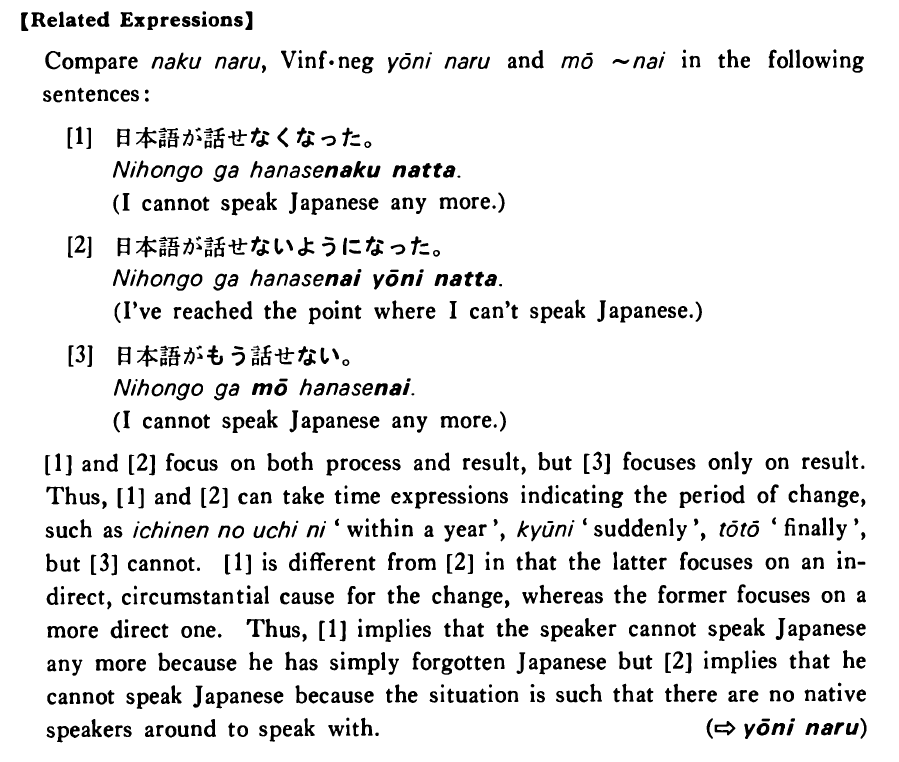
Compare なくなる, Verb informal negative ようになる and もう~ない in the following sentences:
[1]
[2]
[3]
[1] and [2] focus on both process and result, but [3] focuses only on result. Thus, [1] and [2] can take time expressions indicating the period of change, such as 一年のうちに 'within a year', 急に 'suddenly', とうとう 'finally', but [3] cannot. [1] is different from [2] in that the latter focuses on an indirect, circumstantial cause for the change, whereas the former focuses on a more direct one. Thus, [1] implies that the speaker cannot speak Japanese any more because he has simply forgotten Japanese but [2] implies that he cannot speak Japanese because the situation is such that there are no native speakers around to speak with.
(⇨ ようになる)